The internet creates new words and expressions every day. Some disappear quickly, while others become part of online culture. One term that has attracted attention is Faccccccccccccc. At first impression, it may seem like a simple typing error, an accidental keyboard input, or a meaningless string of characters. Yet many internet users have encountered it on social media platforms, discussion forums, comment sections, and meme pages.
The curiosity surrounding Faccccccccccccc comes from its unusual appearance. Unlike standard words, it does not follow dictionary definitions or traditional grammar rules. Despite this, people understand that it carries emotion and intent when used in digital conversations. The phrase reflects a growing pattern in digital communication where conveying intent and emotion often becomes more important than following traditional language rules.
This article explores what Faccccccccccccc means, how it emerged, why people use it, and what it reveals about modern internet culture.
What is Faccccccccccccc
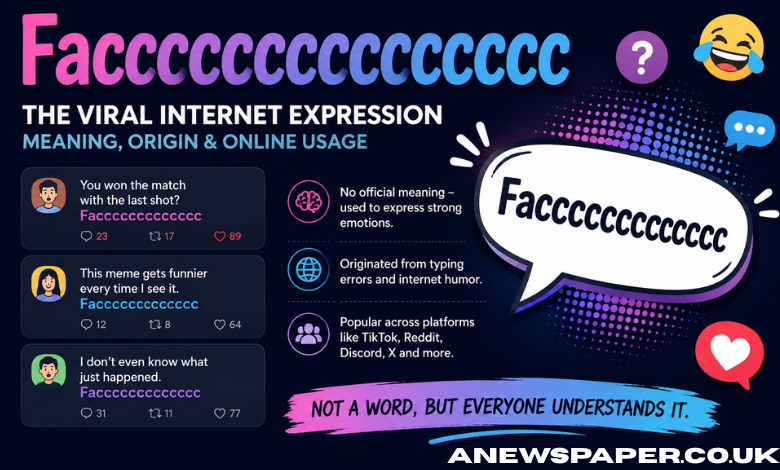
Faccccccccccccc is an internet-based expression made by extending the letter “c” after the sequence “Fac.” It is not officially recognised as a word in any major language, nor does it have a fixed definition. Instead, it functions as a flexible online expression used to communicate emotion, reaction, humour, or emphasis.
The term stands out because of its exaggerated spelling. Similar patterns can be found throughout internet culture. People often write words such as:
- Nooooooo
- Yesssssss
- Whyyyyyy
- Bruhhhhhh
In each case, additional letters are used to increase emotional impact. Faccccccccccccc follows the same principle but in a more exaggerated form.
Rather than conveying a specific meaning, the term acts as a reaction. Its interpretation depends on the situation in which it is used.
Who Is Faccccccccccccc?
One common question is whether Faccccccccccccc refers to a person, character, brand, or online personality.
The simple explanation is that Faccccccccccccc does not refer to an actual individual or identified person.
There is no known public figure, celebrity, influencer, fictional character, or organisation associated with the term. Instead, it is an internet expression used by online communities. The confusion often arises because unusual internet terms sometimes become usernames, gaming handles, meme identities, or social media aliases. However, the expression itself is not connected to a specific individual.
When people ask “Who is Faccccccccccccc?” they are usually trying to understand the source of the term rather than identify an actual person.
The Meaning of Faccccccccccccc
One reason for the popularity of Faccccccccccccc is its flexible meaning.
Unlike ordinary words, it does not have a single definition. Instead, users apply their own interpretation depending on the context.
It can express:
Surprise
Many users type Faccccccccccccc when something unexpected happens.
For example:
“You won the competition after entering at the last minute? Faccccccccccccc!”
In this situation, the term functions as a reaction to an unexpected event.
Frustration
The expression may also communicate annoyance or irritation.
Example:
“The internet disconnected during the final match. Faccccccccccccc.”
Here, the term acts as a digital sigh.
Excitement
Online communities frequently use exaggerated spelling to show enthusiasm.
Example:
“My favourite artist just announced a new album. Faccccccccccccc!”
The emotional intensity is reflected through the repeated letters.
Confusion
Users may type the expression when they do not understand what is happening.
Example:
“I read that post three times and still don’t get it. Faccccccccccccc.”
In this context, it represents bewilderment.
Humour
Sometimes there is no serious meaning behind the term at all. People use it simply because it looks funny.
Internet culture often values absurdity, and Faccccccccccccc fits perfectly within that style of communication.
The Possible Origin of Faccccccccccccc
The exact origin of Faccccccccccccc is unknown.
Unlike established words with documented histories, internet expressions often emerge spontaneously and spread without clear records.
Several theories explain how the term may have started.
The Typing Error Theory
The most widely accepted explanation is that the term began as a keyboard mistake.
One possible explanation is that a user entered “Fac” and unintentionally continued pressing the “c” key, creating an extended version of the word. Instead of deleting the extra letters, they left them in place.
Other users found the mistake amusing and began repeating it intentionally.
This pattern is common online. Many internet expressions started as errors before becoming popular slang.
The Reaction Meme Theory
Another possibility is that the expression emerged from reaction memes.
Internet users often create exaggerated responses to images, videos, or jokes. A stretched word such as Faccccccccccccc naturally fits the style of exaggerated internet humour.
Over time, repeated use could have transformed it into a recognisable online expression.
The Community Adoption Theory
Many internet terms become popular because communities collectively adopt them.
A phrase may appear in a gaming server, forum, or social media group before spreading elsewhere.
Once enough people start using it, the expression develops a life of its own regardless of its original source.
Why Faccccccccccccc Became Popular
Several factors explain why unusual expressions gain attention online.
Visual Impact
Faccccccccccccc immediately catches the eye.
Most written content follows predictable spelling patterns. A word containing a long sequence of repeated letters breaks that pattern.
When users scroll through social media feeds, unusual text naturally attracts attention.
Emotional Expression
Online communication does not naturally include visual cues, vocal tone, or physical gestures that help express meaning in face-to-face conversations.
To compensate, users modify language.
Repeated letters help convey emotion more clearly than standard spelling.
Faccccccccccccc works as a visual representation of strong feelings.
Humorous Appeal
Internet culture often embraces nonsense and absurdity.
Not every popular expression needs a logical explanation.
Sometimes people enjoy using a phrase simply because it is unexpected and amusing.
Ease of Use
The term requires no explanation within many online communities.
Users instantly recognise it as an emotional reaction even if they cannot define it precisely.
This simplicity contributes to its spread.
Faccccccccccccc and Modern Internet Language
The rise of Faccccccccccccc reflects broader changes in online communication.
Traditional language follows formal rules involving grammar, spelling, and vocabulary. Internet language often operates differently.
Online users prioritise:
- Speed
- Emotion
- Creativity
- Humour
- Visual expression
As a result, unconventional expressions thrive.
Examples include:
- LOL
- LMAO
- SMH
- Bruh
- Yeet
- Oof
Many of these terms would have seemed unusual when they first appeared.
Faccccccccccccc belongs to the same category of internet-driven communication.
How Social Media Influences Expressions Like Faccccccccccccc
Social media platforms play a major role in spreading internet language.
TikTok
Short-form videos encourage quick reactions.
Users frequently comment with exaggerated expressions to capture emotions instantly.
Terms such as Faccccccccccccc fit naturally into this environment.
Discussion communities often create inside jokes and niche expressions.
Uncommon expressions often become popular when users repeatedly share and reference them in different discussions.
Discord
Gaming and community servers frequently generate unique slang.
Members adopt expressions that strengthen group identity.
X
Fast-paced conversations encourage brief and memorable reactions.
Expressions like Faccccccccccccc stand out in crowded comment sections.
The Psychology Behind Repeated Letters
There is an interesting psychological reason why people extend letters in online communication.
Humans naturally seek ways to express emotion.
In face-to-face conversation, emotion comes through:
- Voice tone
- Facial expressions
- Gestures
- Body language
Text removes these elements.
Repeated letters act as substitutes.
Consider these examples:
- Fine
- Fiiiiine
Despite using the same basic letters, each version communicates a distinct feeling and level of intensity.
Faccccccccccccc operates on the same principle. The extended sequence creates intensity that standard spelling cannot achieve.
Can Faccccccccccccc Become a Real Word?
Language constantly evolves.
Many words now accepted in dictionaries were once considered informal slang.
Examples include:
- Selfie
- Blog
- Emoji
- Podcast
Whether Faccccccccccccc will follow the same path remains uncertain.
Several factors influence the transition from slang to recognised vocabulary:
Consistent Usage
A term must maintain popularity over time.
Shared Meaning
Users need to develop a common understanding of what the expression represents.
Cultural Relevance
The word must remain useful beyond a temporary trend.
At present, Faccccccccccccc remains an informal internet expression rather than a recognised dictionary term.
Examples of How People Use Faccccccccccccc
The flexibility of the expression allows it to appear in many situations.
Reacting to Unexpected News
“You got promoted after only six months? Faccccccccccccc!”
Responding to Gaming Moments
“That final move was unbelievable. Faccccccccccccc!”
Expressing Frustration
“My laptop crashed before I saved the file. Faccccccccccccc.”
Reacting to Memes
“I’ve seen this meme countless times, yet it somehow becomes funnier with every revisit. Faccccccccccccc.”
Showing Disbelief
“You ate the entire pizza by yourself? Faccccccccccccc.”
These examples illustrate how the meaning shifts according to context.
The Role of Randomness in Internet Culture
Faccccccccccccc also highlights the internet’s appreciation for randomness.
Many online trends succeed because they are unusual rather than meaningful.
Random humour often spreads faster than carefully planned content because it feels spontaneous.
Users enjoy participating in shared jokes that do not require detailed explanations.
This collective sense of amusement helps unusual expressions gain visibility.
Will Faccccccccccccc Remain Popular?
Predicting internet trends is difficult.
Some expressions disappear within weeks.
Others remain part of online culture for years.
The future of Faccccccccccccc depends on:
- Continued community use
- Social media visibility
- Meme culture
- Adaptability
Even if Faccccccccccccc eventually disappears from online conversations, the creative style behind it will continue shaping internet communication. Internet users will keep creating new expressions through repetition, exaggeration, and playful spelling.
Conclusion
Faccccccccccccc is an example of how internet culture creates meaning outside traditional language rules. Although it is not a dictionary word and does not refer to a specific person, it functions as a flexible digital expression that conveys emotion, humour, surprise, frustration, excitement, and confusion. Its appeal comes from its visual impact, emotional intensity, and adaptability. Whether it began as a typing mistake, a joke, or a community-created expression, it demonstrates how online communication continues to evolve beyond conventional grammar. More importantly, Faccccccccccccc reflects a broader reality of modern digital interaction: people often communicate feelings through creativity rather than strict language rules. In online spaces, an unusual collection of letters can become meaningful simply because communities decide to use it that way. As internet culture continues to change, expressions like Faccccccccccccc remind us that language is not fixed. It adapts to the ways people connect, react, and share experiences in the digital world.