The phrase dado à appears in different online texts, language discussions, and informal writing, often creating confusion for readers who are not familiar with Romance languages. At first glance, it looks simple, but its meaning depends on context, grammar, and the language in which it is used. Because it is not a fixed term in English, people often try to interpret it using intuition, which leads to mixed understanding. In reality, dado à comes from linguistic structures found mainly in Portuguese and Spanish grammar, with influence from French phrasing in some uses. It can function as part of a grammatical construction, or as a stylistic expression in creative writing. The phrase becomes more interesting when it is placed in different contexts, because its meaning shifts slightly depending on how it is used.
Understanding dado à requires looking at its grammatical role, its literal translation, and the way it appears in modern usage. It is not a standalone concept but a building block of expression.
What Does Dado à Mean?
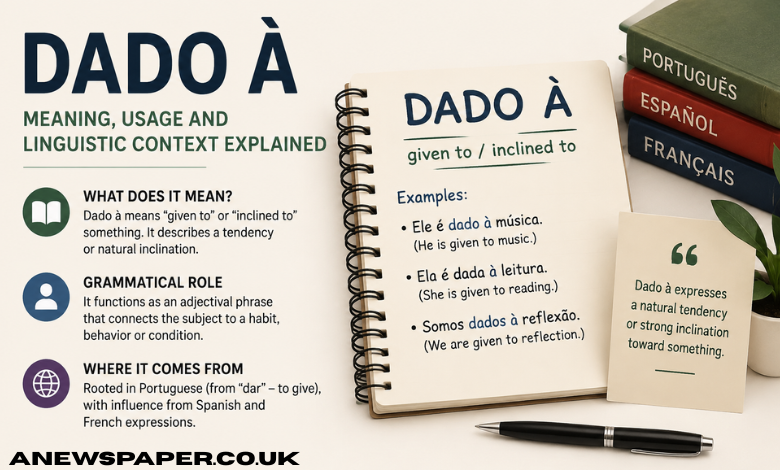
At its most basic level, dado à comes from the verb dar, which means “to give” in Portuguese and Spanish. The word dado is a past participle form meaning “given.” The preposition à is a contraction of “a + a” in Portuguese, often translated as “to the,” “at the,” or “toward the,” depending on context. When combined, dado à roughly suggests “given to” or “inclined to” something. However, this literal translation does not fully capture its practical usage. In real language use, dado à often introduces a tendency or condition. For example, a person might be described as dado à reflexão, meaning “given to reflection” or someone who tends to reflect often. In this sense, it describes a habitual behavior or natural inclination.
The meaning changes depending on what follows the phrase, which is why it is not fixed. It works more like a grammatical connector than a complete expression.
Linguistic Origin and Structure
To understand dado à properly, it helps to break it into parts.
1. “Dado”
The word dado is a participle form derived from Latin roots. It is used in Portuguese and Spanish to indicate something that has been given, assigned, or provided. It carries a passive sense, meaning the action has already happened.
2. “à”
The element à is a contraction of “a + a” in Portuguese. It is used when a preposition meets a feminine article. It is similar to saying “to the” in English, but its role is more flexible depending on sentence structure.
3. Combined Structure
When combined, dado à forms a grammatical link that connects a subject to a concept, action, or quality. It does not stand alone as a noun or verb phrase. Instead, it modifies meaning in relation to what comes after it.
This structure is typical in Romance languages, where phrases often carry layered meanings through small grammatical markers.
Grammatical Function of Dado à
In Portuguese grammar, dado à functions as part of an adjectival or participial phrase. It helps describe a subject by linking it to a behavior or condition.
For example:
- Ele é dado à música
This translates to “He is given to music,” meaning he has a strong inclination toward music. - Ela é dada à leitura
This translates to “She is given to reading,” meaning she enjoys reading or tends to read often.
In these examples, dado à is not describing a single action but a tendency. It shows personality traits or habits in a compact grammatical form.
Gender and Number Agreement
One important feature of dado à in Portuguese is agreement. The phrase changes depending on the subject:
- Masculine singular: dado à
- Feminine singular: dada à
- Masculine plural: dados à
- Feminine plural: dadas à
This agreement is necessary for grammatical correctness and reflects the structure of Romance languages, where gender and number play a central role in sentence formation.
Stylistic and Modern Usage
While dado à is primarily grammatical, it also appears in more creative and modern writing. In some cases, writers use it in a stylized form to create expressions like “dado à perfeição” or similar constructions. In such cases, the phrase is used to emphasize precision or completeness. For example, “done to perfection” becomes stylistically expressed as something that has been dado à perfeição, blending Portuguese and French influence. This kind of usage is more common in artistic writing, branding, or poetic expressions rather than formal grammar. It is not standard in everyday speech but is understood in context. The blending of languages is not unusual in digital communication, where phrases are often mixed for stylistic effect.
Why People Get Confused by Dado à
There are several reasons why dado à creates confusion among readers.
1. It is not English
Most confusion comes from the fact that dado à is not an English phrase. People encountering it in English text often try to interpret it literally, which leads to incorrect assumptions.
2. It looks incomplete
Without context, the phrase looks unfinished. It requires a continuation, such as a noun or concept after it. Without that, it feels like something is missing.
3. Mixed language exposure
In online content, dado à sometimes appears alongside French or Spanish words. This makes it harder to identify its origin and meaning.
4. Stylized writing
Writers sometimes use the phrase for artistic effect without explaining it, which adds to the uncertainty.
Because of these factors, readers often search for clarification when they encounter it.
Dado à in Cross-Language Context
Dado à exists in a space shared by Portuguese, Spanish, and French linguistic influences. While it is primarily Portuguese in structure, similar constructions exist across Romance languages. In Spanish, a similar idea can be expressed using dado a, which also means “given to” or “inclined toward.” In French, expressions like donné à carry comparable meanings, though usage rules differ. This overlap shows how Romance languages share grammatical roots but develop slightly different usage patterns. As a result, phrases like dado à can feel familiar across languages even when they are not identical.
Functional Meaning in Everyday Communication
In practical usage, dado à helps describe personality traits, habits, or tendencies. It is not usually used for direct actions but rather for describing someone’s general behavior.
For example:
- A person who spends a lot of time thinking may be described as dado à reflexão.
- Someone who enjoys sports may be described as dado à prática esportiva.
- A person who avoids social interaction might be described as dado ao isolamento.
These expressions are compact and efficient. Instead of using longer sentences, the phrase conveys meaning quickly.
This is one reason why it remains useful in formal writing and literature.
Evolution of Usage in Modern Contexts
Although dado à is rooted in traditional grammar, its usage has evolved with digital communication. Online writing often simplifies or repurposes traditional expressions. In some cases, dado à appears in usernames, branding, or creative phrases without strict grammatical rules. This flexibility allows the phrase to move beyond formal language. However, it also increases misunderstanding because not all uses follow standard grammar. In modern usage, context becomes more important than structure. Readers rely on surrounding words to interpret meaning rather than the phrase itself.
Common Misinterpretations
Several common misinterpretations of dado à appear online:
- Thinking it is a fixed English phrase
- Assuming it always means “perfect” or “complete”
- Treating it as a standalone expression without context
- Confusing it with unrelated French expressions
These misunderstandings usually come from isolated exposure without grammatical background. Once the structure is understood, these errors become less common.
Importance in Language Learning
For learners of Portuguese or Spanish, dado à is a useful example of how participial phrases work. It demonstrates how verbs transform into descriptive structures and how prepositions connect ideas.
Understanding this phrase helps learners:
- Recognize gender and number agreement
- Understand participle usage
- Interpret tendencies and habits in sentences
- Improve reading comprehension in Romance languages
It is not a high-frequency phrase, but it is valuable for understanding grammar patterns.
Conclusion
The phrase dado à is a small but meaningful part of Romance language structure. It comes from the verb “to give” and functions as a grammatical connector that describes tendencies, habits, or inclinations. While it may appear simple, its meaning depends heavily on context and sentence structure. Its presence in modern writing, especially online, shows how traditional grammar continues to influence contemporary communication. At the same time, its mixed usage across languages and creative contexts can lead to confusion. Understanding dado à is less about memorizing a fixed definition and more about recognizing how it works within sentences. Once this structure is clear, the phrase becomes a useful example of how language builds meaning through small but important grammatical elements.