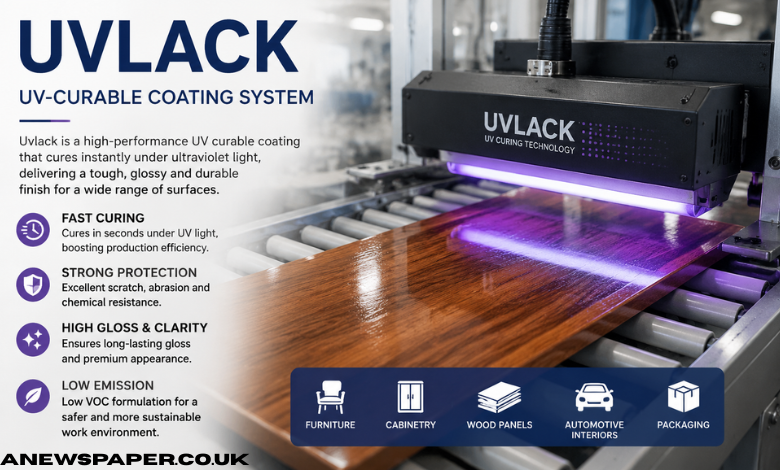
Uvlack is a UV-curable coating system used to protect and finish surfaces across multiple industries. It belongs to a category of coatings that harden when exposed to ultraviolet light, forming a solid protective layer in a very short time. The main purpose of Uvlack is to improve durability, appearance, and production efficiency in manufacturing processes where surface finishing is important. Unlike traditional coatings that rely on air drying or heat curing, Uvlack uses a light-driven chemical reaction. This change in curing method has made it relevant in sectors that need faster production cycles and consistent surface quality. It is commonly applied to materials such as wood, plastic, metal, and composite boards, depending on the formulation.
The growing interest in Uvlack is tied to three practical needs in manufacturing: reducing production time, improving surface resistance, and maintaining consistent visual quality over long use periods.
What Uvlack Actually Is
At its core, Uvlack is a liquid coating that remains in a fluid state until exposed to ultraviolet light. Once exposed, it rapidly transforms into a hardened layer through a process called UV curing. This process is driven by photoinitiators, chemical compounds inside the coating that react when exposed to UV energy. When UV light hits the coating, these photoinitiators trigger polymerization. This means small molecular components link together to form long, stable chains. These chains create a cross-linked structure that gives the coating its hardness and resistance. This structure is important because it changes how the surface behaves under stress. Instead of remaining soft or slowly curing over hours or days, the coating becomes solid within seconds or minutes, depending on the system used.
Uvlack is not a single fixed product but a category name used for UV-curable lacquers with similar functional properties. These systems are formulated to balance appearance, durability, and curing speed.
How the Uvlack UV Curing Process Works
The UV curing process behind Uvlack follows a structured sequence:
First, the coating is applied to the surface using spraying, rolling, or curtain coating methods. The liquid layer is kept uniform to ensure even curing. Next, the coated surface passes under a UV light source. These lights emit specific wavelengths designed to activate the photoinitiators in the coating. Once exposed, the photoinitiators break down and create reactive particles. These particles start a chain reaction that links resin molecules together. This reaction happens almost instantly. As the molecular chains form, the liquid coating turns into a solid film. This film becomes tightly cross-linked, which is the key reason for its mechanical strength. Finally, the surface is ready for immediate handling or further processing. There is no long drying phase, which reduces production delays. This process differs significantly from solvent-based coatings, which rely on evaporation. In UV curing, the transformation is chemical and light-driven, not dependent on air exposure.
Material Composition and Structure
Uvlack formulations typically include several core components:
- Oligomers that form the backbone of the coating
- Monomers that adjust viscosity and flexibility
- Photoinitiators that start the curing process
- Additives that control gloss, flow, and surface behavior
Once cured, these components form a dense polymer network. The structure is tightly bound, which makes it resistant to scratching, chemical exposure, and wear.
The cross-linked nature of the coating is a key reason it performs well in demanding environments.
Key Functional Properties of Uvlack
Uvlack is used in industrial settings because of a specific set of functional properties that support both manufacturing efficiency and product performance.
Fast curing speed
One of the most important features is the curing speed. Since the coating hardens under UV light, production lines can move quickly without waiting for drying time. This reduces bottlenecks in manufacturing workflows.
Surface durability
Once cured, the coating forms a hard protective layer that resists scratches, abrasion, and general wear. This makes it suitable for surfaces that are handled frequently or exposed to daily use.
Chemical resistance
The cross-linked structure provides resistance against household chemicals, solvents, and cleaning agents. These substances do not easily penetrate or damage the surface film.
Gloss stability
Uvlack coatings maintain their surface appearance over time. The gloss level remains stable, which helps products retain a consistent visual quality even after extended use.
Low emission characteristics
Compared to solvent-based coatings, UV-curable systems generally release fewer volatile organic compounds. This makes them more suitable for controlled industrial environments where emission reduction is important.
Industrial Applications of Uvlack
Uvlack is used in multiple sectors where surface finishing plays a functional and visual role.
Furniture manufacturing
In furniture production, Uvlack is used to coat wood panels, cabinets, tables, and decorative surfaces. It provides both protection and a consistent finish. The fast curing process allows manufacturers to increase output without expanding production time.
Flooring systems
Some flooring products use UV-curable coatings to improve surface durability. These coatings help protect against scratches, foot traffic, and cleaning chemicals.
Plastics and consumer goods
Plastic components in electronics, appliances, and decorative items often require a smooth and durable finish. Uvlack provides a uniform coating that improves both appearance and resistance.
Automotive interior parts
Interior trims, dashboards, and decorative panels in vehicles may use UV coatings to maintain long-term appearance and resist fading.
Packaging and printed surfaces
In packaging industries, UV coatings are used to enhance print quality and protect labels or decorative prints from damage during handling and transport.
Advantages in Manufacturing Environments
From a production perspective, Uvlack is valued not only for its final finish but also for how it changes workflow efficiency. One major advantage is reduced production time. Since curing happens almost instantly under UV light, manufacturers can move products through finishing stages much faster than with traditional coatings. Another advantage is space efficiency. Traditional drying systems often require long curing areas or storage time. UV systems reduce this requirement, allowing more compact production layouts. Consistency is another factor. Because curing is controlled by light exposure rather than environmental conditions, results are more predictable. Waste reduction also plays a role. Faster curing and controlled application reduce the risk of defects that would require rework.
Limitations and Technical Constraints
Despite its advantages, Uvlack is not suitable for every application. One limitation is surface accessibility. UV light must reach the coating for curing to occur. Complex shapes or hidden areas may not cure properly unless specialized equipment is used. Another constraint is equipment cost. UV curing systems require specific lamps and controlled environments, which can increase setup costs for manufacturers. Material compatibility is also important. Not all substrates respond well to UV coatings without proper surface preparation. In addition, safety precautions are required because UV light exposure can be harmful to skin and eyes if not properly controlled.
Environmental and Operational Considerations
Uvlack systems are often selected for their relatively lower environmental impact compared to solvent-heavy alternatives. The reduction in volatile emissions is a key factor in modern production environments. However, energy use from UV lamps and equipment maintenance are operational factors that must be considered. While curing is fast, it depends on consistent energy input from UV sources. Proper ventilation and safety systems are also necessary in production areas where UV curing is used regularly.
Quality and Performance Testing
Industrial use of Uvlack typically involves rigorous testing protocols to ensure consistent performance and reliable quality across production batches. Common tests include:
- Scratch resistance testing
- Chemical exposure testing
- Gloss measurement over time
- Adhesion strength testing
- Heat resistance evaluation
These tests help determine whether a coating formulation meets required standards for its intended application.
Future Direction of UV-Curable Coatings
The development of UV-curable coatings like Uvlack is moving toward improved efficiency and broader material compatibility. Research is focused on reducing energy requirements, expanding curing capabilities for complex shapes, and improving formulation stability. There is also ongoing development in water-based UV systems and hybrid coatings that combine UV curing with other technologies. These developments aim to expand where UV coatings can be used while maintaining performance benefits. Automation is another direction. Modern production lines are increasingly integrating UV curing systems with robotic application and quality control systems to improve consistency and reduce manual handling.
Conclusion
Uvlack represents a practical application of UV curing technology in industrial surface finishing. Its value lies in its ability to combine fast processing, durable surface protection, and consistent visual quality. The system operates through a light-activated chemical reaction that quickly converts liquid coatings into durable solid protective layers within seconds. This shift has made it useful in industries where production speed and surface reliability are important. While it has limitations related to equipment, surface access, and setup requirements, its advantages continue to make it a widely used solution in manufacturing environments. As coating technology evolves, systems like Uvlack are likely to remain central to how industries approach surface finishing and product durability.