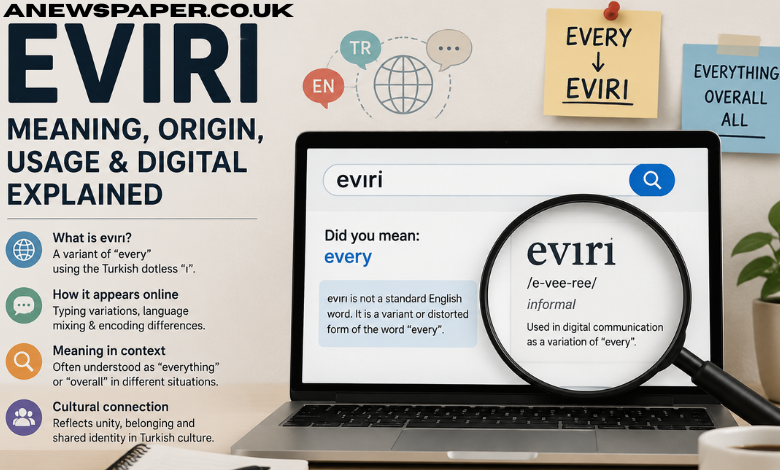
The term evırı has started to appear across search engines, social media posts, comment sections, and short-form digital content. At first glance, it looks like a word from a foreign language or a technical term used in linguistics. However, when people try to trace it in dictionaries or formal references, they quickly find that it does not exist as a standard English word. This gap between appearance and definition is exactly what has made evırı interesting. Users encounter it in digital spaces, assume it carries meaning, and then search for clarification. In most cases, the search intent is simple: people want to know whether it is a real word, a translated concept, or something with cultural or technical significance.
In practical terms, evırı is best understood not as a formal vocabulary item, but as a modified or distorted form of the English word “every.” The replacement of the final letter “y” with the Turkish dotless character “ı” changes both its visual structure and its linguistic identity. This small alteration is enough to create confusion, curiosity, and repeated searches.
What “evırı” actually is in linguistic terms
From a linguistic perspective, evırı does not belong to any recognized dictionary system in English, Turkish, or other major languages. It is not part of standard grammar, and it does not have an official definition in academic language resources. The most widely accepted explanation is that it originates from the English word “every,” altered through character substitution. The final “y” is replaced by “ı,” a letter used in Turkish that represents a vowel sound distinct from the English alphabet.
This type of transformation often happens in digital communication environments where:
- keyboards switch between language layouts
- users copy text between systems that handle characters differently
- fonts or encoding systems replace unsupported letters
- informal typing leads to accidental substitutions
As a result, every can visually shift into evırı, even though the meaning was never intentionally changed.
This makes evırı a good example of how digital writing environments can unintentionally create new “words” that feel real but do not have formal linguistic status.
How digital environments produce terms like evırı
The internet has changed how language behaves. Words no longer stay fixed; they move across platforms, devices, and encoding systems. In that process, distortions are common.
Evırı can emerge in several ways:
1. Keyboard layout switching
Users typing in multilingual environments may switch between English and Turkish layouts. When this happens, certain letters are replaced or misinterpreted.
2. Encoding and font substitution
Some systems do not properly support special characters. When the system cannot render a letter correctly, it may substitute a visually similar character. The dotless “ı” is often involved in such cases.
3. Typing errors and autocorrect behavior
Autocorrect systems sometimes replace intended letters based on prediction models. A simple mistype can be stored and repeated across platforms.
4. Copy-paste propagation
Once a distorted word appears online, it can spread through reposts and copied content. Over time, the incorrect form becomes more visible than the original.
These mechanisms explain how evırı can appear consistently in online environments without ever being intentionally defined.
Meaning in context: why people assign interpretation to evırı
Even though evırı has no fixed dictionary definition, it is often interpreted based on context. In most cases, it is connected to the meaning of “every,” which carries ideas of completeness or totality.
Because of this association, people tend to understand evırı in a flexible way. Depending on the sentence or usage, it may imply:
- everything in a group or category
- a continuous or ongoing condition
- an inclusive reference to all elements in a set
- a general or collective idea rather than a specific item
This interpretive flexibility is common in digital language, where users often prioritize meaning over correctness. If a term appears understandable in context, it becomes functionally usable even without formal recognition.
The SEO and search behavior perspective
From a search engine optimization perspective, evırı is an interesting example of an “intent-driven keyword.” This means that people are not searching for a definition they already know; instead, they are searching to resolve uncertainty.
Search behavior around such terms usually follows a pattern:
- User encounters unfamiliar word
- User assumes it may be meaningful
- User searches for explanation
- User reads multiple interpretations
- Word gains visibility due to repeated searches
This cycle increases the presence of the term in search engines, even though it has no formal definition.
Content that explains such terms tends to perform well because it satisfies informational intent. Users want clarity, not persuasion or opinion. As a result, articles about evırı usually focus on explanation, origin, and usage rather than promotion or storytelling.
Cultural confusion and language blending
Another reason evırı appears online is the blending of languages in digital communication. English is often mixed with other language systems, especially in regions where multilingual users switch between scripts.
The use of the Turkish dotless “ı” is particularly important here. In Turkish, this letter is not equivalent to the English “i” or “y,” which means that when it appears in an English word, it creates visual and phonetic confusion.
This type of blending is not limited to Turkish and English. Similar patterns appear in other language combinations where scripts interact, such as:
- Latin and Cyrillic mixing
- Arabic script transliteration into English
- Asian language romanization inconsistencies
Evırı is one small example of a larger global pattern where digital communication merges writing systems in unexpected ways.
Interpreting evırı beyond its literal form
Although evırı is technically a distorted form of “every,” it can still be interpreted in broader conceptual terms. In informal usage, people sometimes treat it as a symbolic or abstract expression.
In this sense, it may represent:
- completeness without structure
- general inclusion without limitation
- a conceptual “whole” rather than a defined part
This kind of interpretation is not linguistic in a strict sense but reflects how users assign meaning based on familiarity and context. When a word feels recognizable, people tend to build meaning around it even if it is not formally defined.
Why unclear terms like evırı persist online
There are several reasons why terms like evırı continue to circulate:
1. Repetition in digital content
Once a term appears in multiple posts or comments, it gains visibility regardless of correctness.
2. Lack of verification in informal spaces
Social media and comment sections rarely require linguistic accuracy. As long as a term is understood by a group of users, it continues to be used.
3. Algorithm amplification
Search engines and recommendation systems promote frequently searched or engaged terms, even if they are incorrect or informal.
4. Curiosity-driven search behavior
Users encountering unknown words tend to search them, which increases traffic and reinforces visibility.
These factors combine to give terms like evırı a digital presence that is disproportionate to their actual linguistic status.
The broader lesson about digital language
The case of evırı highlights a broader reality about how language behaves online. Words are no longer static units defined only by dictionaries or academic institutions. Instead, they are shaped by usage patterns, typing behavior, and platform dynamics.
In this environment:
- spelling variations can become search terms
- errors can evolve into recognizable forms
- informal usage can spread faster than formal definitions
- meaning is often derived from context rather than rules
This does not mean language has lost structure. Instead, it shows that structure now exists alongside fluidity.
Conclusion
Evırı is best understood as a digital language artifact rather than a formal word. It originates from the English “every,” altered through character substitution involving the Turkish dotless “ı.” While it does not have an official definition, it is often interpreted as representing completeness or inclusiveness depending on context. Its appearance in online spaces is not unusual. It reflects how modern communication systems handle multilingual input, encoding variations, and informal typing habits. Over time, such terms gain visibility simply because users search for explanations and share interpretations. In practical use, evırı should not be treated as a standardized term. Instead, it serves as an example of how digital environments can reshape written language, creating forms that exist between error, adaptation, and emerging meaning.